
Lightning protection
ESE or conventional lightning protection: which is right for your building?
A plain-language comparison of early streamer emission (ESE) and conventional lightning protection systems for buildings in Rwanda, and how to choose.
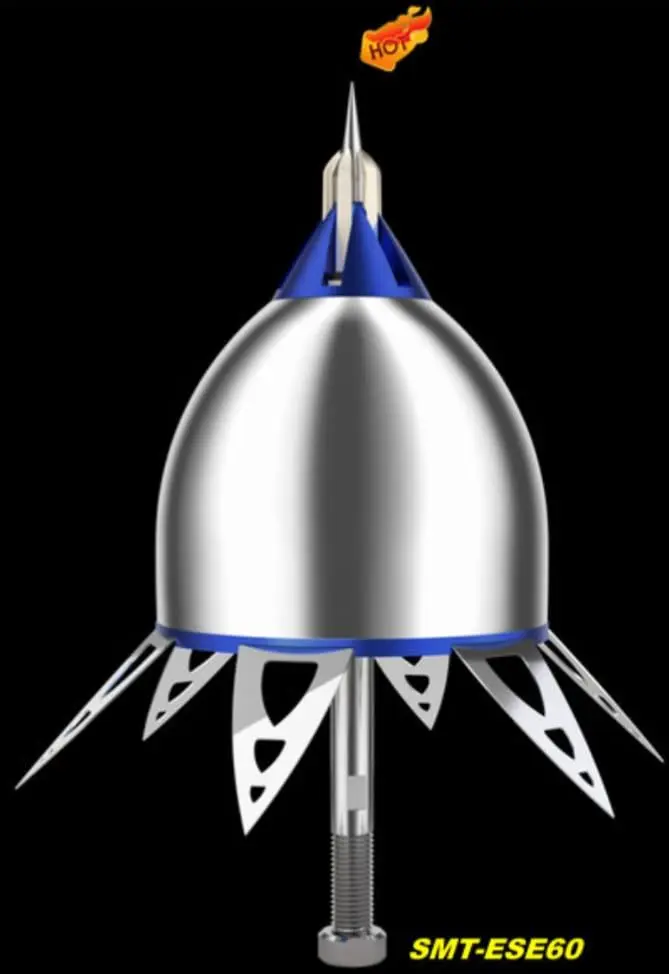
Every external lightning protection system does the same three jobs: it intercepts the strike, carries the current safely down the outside of the building, and disperses it into the ground. The difference between the two main approaches is how the strike is intercepted.
Conventional systems (IEC 62305)
A conventional system uses air rods and a mesh of conductors across the roof. The protected zone is calculated with methods defined in IEC 62305-3, such as the rolling sphere, protective angle or mesh method. Conventional systems are well established and suit buildings with simple roofs and where many rods and conductors are acceptable.
Typical strengths:
- Simple, well-understood design method
- Suits flat roofs, industrial sheds and small structures
- Components are widely available
Typical limitations:
- Large roofs need many rods and long conductor runs
- More roof penetrations and visual impact
- Installation time grows with roof area
Early streamer emission systems (NF C 17-102)
An ESE air terminal is designed to emit an upward streamer earlier than a simple rod when a storm approaches. The standard NF C 17-102 defines how the terminal is tested and how its protection radius is calculated from its tested performance, its height and the protection level of the building.
Typical strengths:
- One terminal can protect a large area, which suits campuses, schools and hospitals with several blocks
- Fewer conductors on the roof and less visual impact
- Faster installation on large or complex roofs
Typical limitations:
- Performance depends on correct testing to NF C 17-102, so test reports from independent laboratories matter
- The mast must be high enough above the structure to achieve the calculated radius
What both systems need
Whichever interception method you choose, the system is only as good as its down conductors and earthing. A low-resistance earth, correct conductor routing, test joints and properly made connections, ideally by exothermic welding, are essential. External protection also does not protect the equipment inside: surge protection devices on power, data and telecom lines are needed for that.
How to choose
Start with a risk assessment. It tells you whether protection is needed and which protection level applies. Then compare designs for your actual roof:
- How large and complex is the roof, and how many blocks need protection?
- Can one or two ESE terminals cover the area, or would a conventional mesh be simpler?
- What are the installation and maintenance costs of each option?
- Are test reports available for the ESE terminal being offered?
For many schools, health facilities and multi-block campuses in Rwanda, an ESE system gives full coverage with fewer components. For small, simple buildings, a conventional system can be the most economical choice. A good contractor will show you both and explain the trade-offs.
Our approach
ELEMAC designs and installs both ESE systems to NF C 17-102 and conventional systems to IEC 62305, with earthing and surge protection designed together. We provide calculations, drawings and manufacturer test reports, and we test every system at handover.
Not sure which system suits your site?
Our engineers carry out a lightning risk assessment and recommend the right system for your building.
Request a lightning site survey